Thursday, October 9, 2014

Strasbourg, Wednesday October 8

The day started out kind of dark and rainy, but we went ahead with our plans to head in to Strasbourg for the weekly Untour orientation and general ‘how's it going’ meeting (and free lunch). We did feel quite well oriented already, but there was still lots for us to see and do in Strasbourg, and it was a chance to reunite with the two participants in last week’s drawing class and see how things were going for them.

Our plans to again take the train from Sélestat fell through when we discovered that the parking spaces near the station were totally filled up, except for those limited to just over two hours. Commuters no doubt. But Sélestat is on the way to Strasbourg, so we just kept going in our car. Strasbourg parking was easy, thanks to a sign at the edge of town pointing us to a conveniently located garage and announcing that there were over 200 vacant spaces available at that moment.

The garage was located just across from the lower left corner of the Grande Île as shown on the map in last Saturday’s blog. The bridge we chose to walk across was actually a two-story building with floodgates beneath it. In the event of siege they could open the gates and flood the approach to town. The main floor of the building was now used for display of ancient artifacts such as gargoyles and statues preserved from buildings that apparently are no longer in existence.


 Retired gargoyles


 Strange mixes of people and mythical animals

My kingdom for the other half of my horse!

We had plenty of time before the noon meeting, so we walked around the cathedral area for a while and then settled in at the nearby Maison Naegel for coffee and hot chocolate, a bit of pastry, and a chair to sit in. The food offerings there were very attractive, but we knew that a good lunch would be coming up soon and didn’t want to spoil our appetites too awfully much.

But we couldn’t resist capturing some of the goodies in the window to feast upon here in our memories. Note the three types of eclairs:  vanilla, chocolate, and coffee, with matching custard on the inside. The big fruit tart in the second photo certainly looks worth $36 to me! 


Also tempting was this display of bretzels at a shop across the street.


But we moved on to our appointed meeting place in front of the cathedral, seen here in the background of this drawing done by Sue Anne at the corner of the square.

Below is her quick sketch in markers of the Maison Kammerzell, 1427 AD. It is a show off building of the era. With lots of scuptures, carvings, paintings, and windows. Evidently the only glass available was tiny round ones, sometimes called bulls eyes. That is why you see all those circles. They were a fun challenge to draw.
 

There we met up with the two women from last week’s art class, who reported success in their recent artistic efforts. Shortly afterwards Alicia from Untours arrived, and we learned that the four of us comprised the entire attendance list for the day. It turns out to be the end of the Untours season in Alsace, and we are the final participants till next spring.

Since we all felt well oriented, the ‘meeting’ was a short one. We walked to the other square at the side of the cathedral, took in the view from there, and studied the monument to the stone cutters and masons responsible for this and so many other glorious buildings. Note the various tools of the trade in evidence in the carvings. But the mason himself doesn’t resemble any Masons that we have ever met.


A happy coincidence while we were there: an expat friend of Alicia’s happened to walk by, stopped for a chat, and turned out to be full of interesting historical facts about the cathedral. As is the case with so much we have encountered in Alsace, its background is quite unconventional in comparison to that which one encounters in the rest of France. It wasn’t built by the church but by the top tier of residents in the city, the ones who controlled the various guilds and the local government. It did of course take a few hundred years (400) to complete. It started out Roman Catholic, but then became Protestant for a time, and then went back to Catholic, echoing the various swings in which country controlled the place. We learned more about the class and government structure later in the day at the Musée Historique.

Then it was just a short walk to the Café Restaurant Le Gruber, where lunch was in full  swing.
 The first two floors were utterly crammed with customers, but the staff led us up to the third, where we had a room to  ourselves. For a few minutes. We were cautioned that it too would fill up very soon, so we got our orders in before the remaining crowd arrived.

The meals, ordered individually from the menu this time, were delicious and the conversation enjoyable.

Then we headed back to the square, capturing this zoom lens view of one of the people there at the moment. We then bid au revoir and merci to Alicia, and decided to see the inside of the cathedral.

This time there were no signs forbidding photography or even flash.
The organ was magnificent!
 
 The technological marvel at the far back of the church was this astronomical clock. We lost track of how many things it was computing and ended up buying a book to explain it all.

The area became illuminated just before the 3 o’clock performance of moving figures up at the top, but the performance itself was a dud. Two figures moved a very short distance, and one of them rang a bell on the way by. Did there used to be more action when the clock was first created, or was 3 PM just nap time for the moving figures?
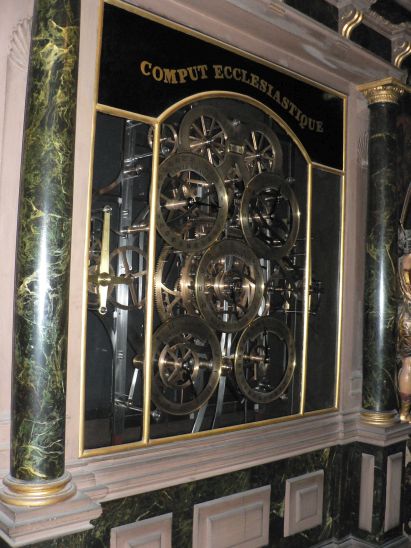
 Here are the gears and dials associated with just one piece of it.

And a view of what time it was everywhere in the world.
Other displays showed date, astrological sign, and lots more.

Then it was au revoir to our two artist friends, and back toward the car with a stop at the very interesting and informative Musée Historique. Our English language headsets provided an excellent narration as we walked through many centuries of Strasbourg.

 The exhibits were very informative, and even hands-on in some cases. Bruce tried on a steel battle helmet (well secured against theft by a chain) but concluded that heads must have been smaller back in those days. It sure was heavy. They even had a set of horse armor on display.

We learned that in the early times there were six social classes, legally defined and among other things required to dress in prescribed clothing styles appropriate to their station. The group at the top constituted the heads of the guilds and high officials of the local government. Upward mobility was certainly not a feature of the times, although a later exhibit did stress the rise of the common soldier Jean Baptiste Kléber to the position of a well respected General in the French Revolution. Kléber was also quite a ladies man. Tall, blond, handsome, he is said to have observed (paraphrased from memory) that “Any man who remains farther than 20 centimeters from a woman is an imbecile.”

Quite amazing was the giant 18th century relief map (3D model) of the city, accurate to the level of streets, buildings, paint colors, and window treatment of the entire place, commissioned by the King Louis of the time. Marvelous narration was provided ‘in the voice of the engineer responsible for its creation’, even speaking in English! And illustrated with holograms. He led a team of people who surveyed every square meter of the city, produced accurate drawings of everything (Urban Sketching on a large scale), and then recreated the place in paper maché at a scale of 1:600. The king had commissioned many of these maps, which he employed in his planning of wartime defenses.

The tour brought us through the many back and forth swings in government, language, religion, and social structure of the place, culminating in the recovery from World War II and the forming of the European Union, whose headquarters is here in Strasbourg—a city symbolic of upheaval and reunion.

Then it was back to the car. This time we chose to take the recently created (50 years or so ago) walkway across the top of the barrier building. There were great views as we bade farewell to Strasbourg with this panorama of the confluence of the River Ill, and settled in for the rush hour drive home to Bergheim, our village.


Wednesday, October 8, 2014

Bergheim, Tuesday October 7

Another day in the local villages. First we wandered around Hunawihr, a small place deeply engaged in wine making activities. You could hear the whir of rotating machinery at the various processing facilities and see lots of trucks, trailers, and other implements all over everywhere. We’ll start with a few pictures that are representative of the ambiance of the place, and then move on.


A view down into a school yard. We love the gate!

A view away from the walled town from the churchyard. We watched massive flocks of birds scanning the entire area, seemingly looking for a vineyard that hadn’t yet been picked. Occasionally they would send a scout down to check things out more carefully.


Vineyards, mountains, and castles (châteaux in French). Ruins of course.
One secret to understanding French vocabulary: both the circumflex and the acute accent are often symbolic of an S that used to exist after the vowel, long ago. Put the S back in and the English word might become recognizable.


Then to the big treat of the day, the butterfly farm (Jardins des Papillons) on the way back from Hunawihr to Ribeauvillé.

First we saw a short video about the butterflies’ life cycle, and then we went into the large, enclosed, climate controlled area, filled with beautiful flowers, where the butterflies had total freedom to fly all over the place.

One thing we learned very early is that most butterflies are nocturnal. So we have no idea how many might have been hidden away for their day-long naps, but there were still lots to be seen. Most had settled in on their favorite type of flower, and some were feasting on some fruit that had been put out for them.


This large blue variety almost seemed like the roaming security force. They wore the right color uniforms, and they spent most of their time flying around in groups of three or four, stopping to check out the action as they made their rounds but rarely settling in. We saw lots of their human counterparts in various public locations in Paris, some quite heavily armed.


On closer inspection, we did learn that the blue ones were especially fond of the fruit put out for them, thin blackish bananas. They looked at first glance like sliced sausages. Perhaps we’ve spent too much time in Alsace? You had to look carefully to identify these butterflies while they were eating, as they tended to fold up their wings and reveal the underside’s mottled brown camouflage pattern. This must serve as great protection against those who would like to attack them while they’re having their meal. Some other varieties were also like that, while others were identical on both sides.

Here’s a montage of some of the many varieties of orchids and butterflies we encountered.


To add to the interest of the place, they also had a couple of chameleons from Madagascar who just loved to perform for the crowds, and another terrariums featuring little brightly colored poisonous frogs from Surinam and Brazil. These are the species that the locals would smear onto their arrowheads to make them especially lethal. According to the signs, the frogs aren’t inherently poisonous, but they eat insects that deposit the poisonous (to others) substances in their bodies. Nature sure works in mysterious ways.


Here’s one of the chameleons. They tended to nap a lot, but when they detected an audience they would put on a show. This fellow is demonstrating how he can climb up the inside of his enclosure with only one foot holding on to the frame and the other three on shiny glass. Their two-part feet make them especially agile. Note his independent eyeballs, each capable of at least 180 degree rotation in all directions.

We saw one woman (not the one shown below!) so enthralled by the chameleon that she got right up to the glass and kissed it.

OK, chameleons, prepare to be drawn!


Drawing chameleons, with butterflies as a distraction


Here we are!

Then we moved on to Ribeauvillé, scene of the Untour orientation lunch last Thursday. In our characterization of the various towns and villages in the area, Ribeauvillé could be described as both touristy and normal. You can buy all the usual tourist things, but there are also places selling the regular supplies of daily living which seemed to be missing or at least well hidden in the purely touristy places. There’s even a hypermarket, relatively small compared to many we’ve encountered elsewhere, but by local standards a large, one-stop place that sells pretty much everything. Walmart light.

Before we even got into the town from the parking lot, we passed this strange structure. We had seen something similar in Bergheim, but with no explanatory sign. Here in Ribeauvillé it was also a mystery till we moved on a bit farther and encountered this very complete illustration. It’s an insect hotel, with accommodations matched to the specific needs of each variety of the beneficial insects.

Since the sign identifies the value of the various species, either as pollinators or as eaters of parasites, and their preferred mode of habitat, we assumed that this display was intended as much as informational for the local agricultural people as it was entertaining for the tourists.

The description at the top center tells of the prowess of the Guêpe (wasp), which in a lifetime of just a few weeks can consume over 2000 harmful insect pests.
 

More storks. We must be in Alsace!
Too big to fit in our suitcases.

 A city gate

 Clever display in a fabric store

And to wrap up the day, a very typical scene from the harvest season.

Tuesday, October 7, 2014

Bergheim, Monday October 6

Monday is Market Day in Bergheim. Considering how small the population of our village is, we weren’t sure what to expect. We weren’t overwhelmed. We counted about 7 sellers there, dealing in the very basics like fruit and vegetables, meat, bread, clothing, plants, and baskets. Sue Anne captured the essence of it in this drawing, and then we went to a supermarket. Shame on us.

Note the gray French sky. The bright blue of the past week sure struck us as atypical. But lovely.

The ornate building in the background is the Hotel de Ville, the town hall.


We thought an enlargement of the figures would add to the visual story too.

Then we took off for Riquewihr, which had been our destination of yesterday but for the overflow of other people with the same idea in mind. Today was much more manageable. 

We can’t offer too very much in terms of interpretive prose, but the pictures and Sue Anne’s drawing will propel you right into the town. It was a lovely place, with most of the streets and structures as they were in the XVI century.

The vineyards are famous for their Riesling wines. We see the farmers bustling around all day with their picking equipment and yellow plastic bins full of pungent smelling green grapes.

This wasn’t our initial view of town, but it seems like a good representation of the entry way to our visit.

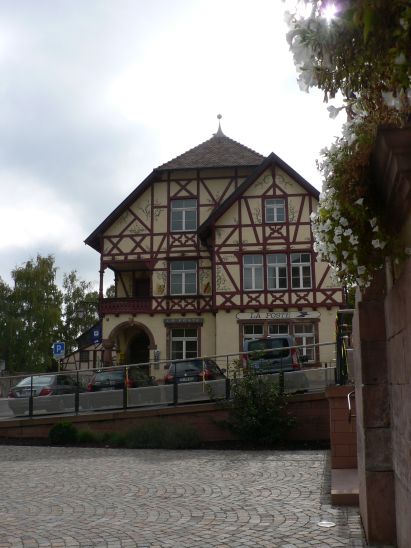
The Post Office with lovely floral painting on the stucco.

 A 19th Century Postal Coach at the Museum of Communication


The vineyards at the edge of town


There’s lots of color in Alsace, and lots of apparent symbols of good luck.

Looking up the hill at the harvest in progress, with the camera set on 12x zoom.
The mechanized device at the right does seem to have pretty aggressive tires, but on a slope like this we would have expected pitons.
They all moved up the hill very quickly. We suspect that it might have been the second pass.

The view up the hill, as seen from in front of the Post Office. The pickers had reached the top by the time the drawing was finished.


Now back into town to check out the various offerings at the souvenir shops.

 This is the famous Choucroute Garnie, sauerkraut with locally cured sausages piled up the side.
We haven’t yet tried any.

  A tarte aux myrtilles is blueberry tart. In Canada the French word for blueberries is not myrtilles, but bluets.  Above the choucroute is a bretzel.

As noted earlier in the blog, the stork image is everywhere and is symbolic of fidelity and fertility. The storks winter as far away as South Africa. The couple returns to the same nest each year, the male arriving first to make repairs. There may be as many as 600 stork couples in Alsace. We would need to return earlier in the year to see the parents and the babies high on their rooftop nests, often situated in permanent facilities provided by the local government or the homeowners.


They come in all sizes.

Here’s ours. He doesn’t yet have a name. It has to be that Alsatian mix of a distinctly French first name coupled with a last name that it totally or almost completely German.
I’m thinking of a last name something like Dachswohner (roof dweller).

And that’s our Monday in Alsace.


Monday, October 6, 2014

Bergheim, Sunday October 5

We slept late after our big day in Strasbourg, stayed around home till after lunch, and then took off in the direction of Riquewihr, a bit to the southwest. It has the reputation of being a very pretty and interesting place. Unfortunately everybody else (especially the bus tours from Germany) seemed to think so as well, and we couldn’t find a vacant parking space anywhere in town. So we decided to put it off to a non-weekend day, and headed back toward Bergheim.

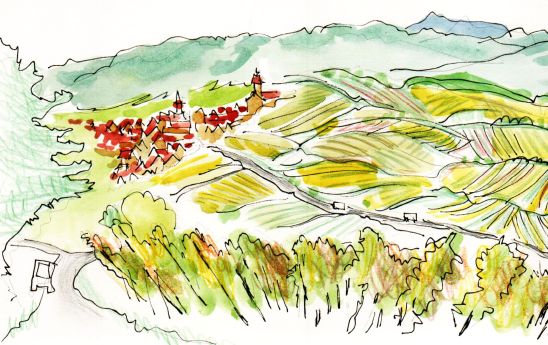
But along the way we spotted a small town sitting on top of a hill, called Zellenberg. It looked like it would offer nice views in all directions, so we drove up the hill to one of quite a few open parking spaces, left the car, and walked around the periphery taking in the sights of mountains, vineyards, and small settlements. It was really quite lovely there.


 Panorama


Closer view

A painting in progress

All done


In the middle ground is the village of Riquewihr, the very much appreciated village. See the tour buses?  We managed to get there the next day.

  The harvest, the vendage, is very nearly over. The leaves of the grape plants are turning a very bright yellow.

The Vosges Mountains are in the far distance.

 Above is a view where the focus is on the mountain range where it meets the fields.

Below, a few more views around the hillside, as we walked in a large circle around the village. It was all dirt roads, with not a tourist in sight, but some hikers.

 Chevrons
  
 Grape leaves in transition


 Very interesting steel gate, with grape leaves outlined in perforations and pressed outward


Then back to Bergheim


There was a concert going on at the church near our house, a benefit for the African nation of Burkina Faso. We have no idea what the connection might have been that brought the concert here to Bergheim, and judging by the sparse attendance neither did too many other people.

The sound is a bit muffled, and the echos and locale do make one tend to believe that it must be church music, but turn the volume up and listen carefully.


Two more lovely homes nearby 

 Then back to this view of the Auberge des Lavandières, scene of the Tartes Brulées of the other night. This time we wanted to illustrate the trough along the side of the road, occupied by a swiftly flowing stream and originally used as a place to do laundry, scrubbing out the especially dirty spots on the stone pavement. Lavandières, built on the same root as the verb laver (to wash), means washerwomen. Though it does also sound very much like the name of the aromatic plant. And the building is lavender color.

An illustration of the washing process at another location, shown on a nearby wall

Now to wrap things up for the day, a couple of maps to help put some of the places we’ve written about in context.

Alsace - With an emphasis on Bergheim
So far we’ve stayed pretty much in the flat country, the valley of the Rhine.
 The Vosges mountains are to the west, with Lorraine on the other side.

Bergheim
 Our house is near the blue dot just above #10